Rules
What a recreational angler may do in Greece, in plain words.
Nothing found. Try another word.
General rules
The basics
No recreational fishing licence is required
No licence of any kind, personal or for the boat, is currently needed for recreational sea fishing or spearfishing. Both were abolished by Article 14(2) of Law 4256/2014. All the other restrictions (quantities, gear, seasons, sizes) continue to apply in full.
Source 1 · Fisheries FAQ – Hellenic Coast Guard, Fisheries Control Directorate
An angler register and catch reporting are on the way
Regulation (EU) 2023/2842 obliges member states to set up a register of recreational fishers and an electronic catch-reporting system. On 30 June 2026 the Ministry of Rural Development told Parliament that the Greek provision was still being drafted and that the IT system would go live once it is enacted. At the time of our check we found no such obligation in force, but this may change soon.
Source 12 · Ministry of Rural Development reply to parliamentary question 5567/25-5-2026 on recreational fishing (30 June 2026)
Foreign-flagged boats
According to the Coast Guard, only Greek-flagged boats may carry out recreational fishing inside Greek territorial waters (Article 32 of Legislative Decree 420/1970 and Article 5 of Regulation (EU) 1380/2013).
Source 1 · Fisheries FAQ – Hellenic Coast Guard, Fisheries Control Directorate
Minimum sizes apply to amateurs too
Recreational fishing is carried out in line with the provisions that apply to commercial fishing as well, so minimum sizes bind the amateur too. A fish under the minimum size goes straight back into the sea; at an inspection it is confiscated.
Source 2 · Presidential Decree 373/1985 on recreational and sport fishing (consolidated text)
How much you keep
Up to 5 kg per angler per 24 hours
Each amateur may keep a total of up to 5 kg of fish or cephalopods (squid, cuttlefish, octopus) per 24 hours, with any permitted gear other than a longline. With a longline the limit is 10 kg. The exception is when a single fish weighs more by itself.
Source 2 · Presidential Decree 373/1985 on recreational and sport fishing (consolidated text)
Only one grouper a day
Of the groupers of the genus Epinephelus (dusky, white, goldblotch and their relatives) only one fish per angler per day may be kept, whatever the gear, spearfishing included. The minimum size is 45 cm. We found no separate, additional ban specific to spearfishing dusky grouper in the official sources we read.
Source 2 · Presidential Decree 373/1985 on recreational and sport fishing (consolidated text)
Selling the catch is forbidden
It is forbidden to sell or otherwise trade fish and seafood taken by recreational fishing. Recreational fishing is fishing for leisure or sport, not for a living or for income.
Source 2 · Presidential Decree 373/1985 on recreational and sport fishing (consolidated text)
Bluefin, albacore and swordfish – not for the amateur
According to the Coast Guard, bluefin tuna, albacore and swordfish may be fished only by professional vessels holding a special permit, and are not part of the amateur's 5 kg. If you hook a bluefin, you release it alive at once. If it dies in the attempt, you inform the port authority, which takes the fish and gives it to a charitable cause. The detailed ICCAT and EU rules on recreational tuna and swordfish fishing were not read separately.
Source 1 · Fisheries FAQ – Hellenic Coast Guard, Fisheries Control Directorate
Octopus – minimum weight
The Coast Guard FAQ states that an amateur may take octopus weighing more than 750 g. Anything smaller goes back into the sea alive. Octopus also counts towards the 5 kg limit.
Source 1 · Fisheries FAQ – Hellenic Coast Guard, Fisheries Control Directorate
Sea urchins – 20 a day, and not all year
Up to 20 urchins a day per angler and up to 30 in total per boat. They may be gathered only with a hand-operated urchin fork or rake, or by free-diving. The Coast Guard inspection sheet gives the permitted period as January, February, March, July, August and December, from one hour after sunrise to one hour before sunset, outside harbours and anchorages and more than 150 m from aquaculture units. Minimum diameter 5 cm without the spines.
Source 3 · Inspection form and instruction sheet for recreational fishing checks
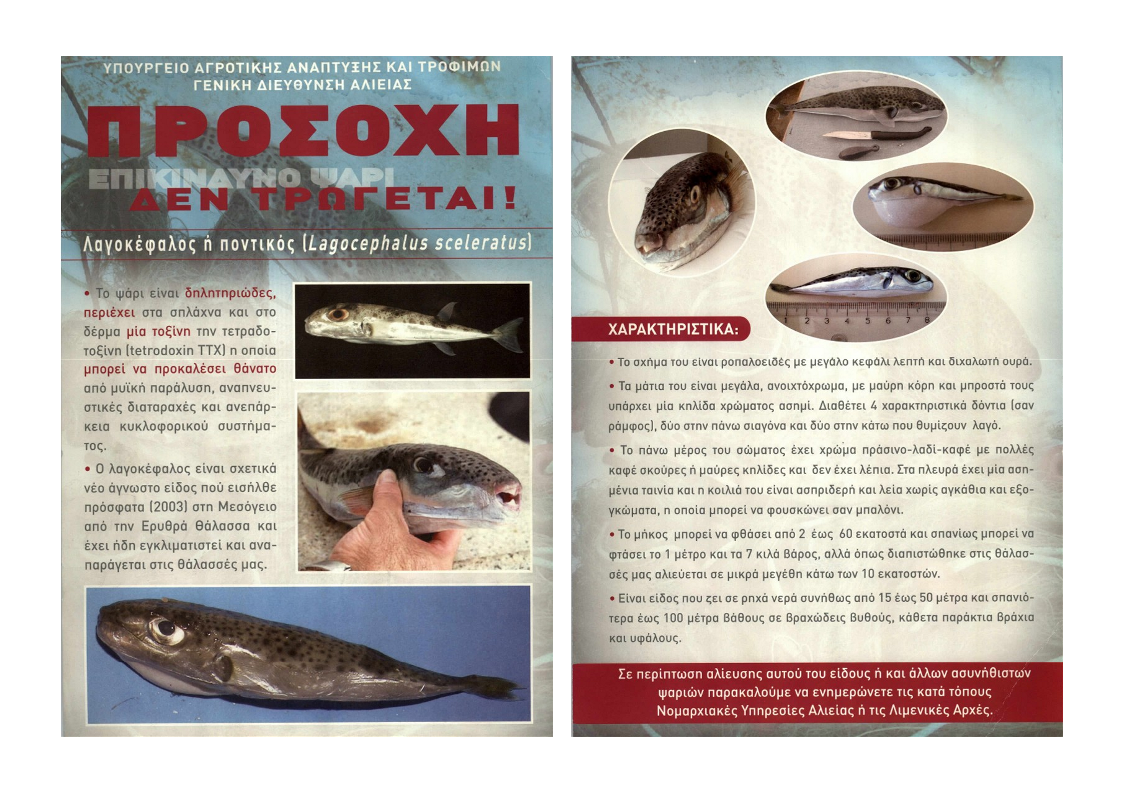
Silver-cheeked toadfish – never eat it
The silver-cheeked toadfish (Lagocephalus sceleratus) is poisonous: its guts and skin contain tetrodotoxin, which can kill. It must not be eaten however it is cooked, nor fed to animals. The Ministry asks you to inform the fisheries service or the port authority when you catch one. Selling it is forbidden in any case, like all recreational catch; the specific EU ban on marketing the poisonous fish of its family was not read during this check.
Source 10 · Ministry leaflet "Warning – dangerous fish, not to be eaten" on the silver-cheeked toadfish
Gear
Which gear is allowed
Allowed without special restriction are the landing net, the hand spear and hooked gear: handline, trolling line, casting line, sabiki, pole, rod and line and the like. Also allowed are a longline with up to 150 hooks per angler and up to 300 in total per boat, up to two traps or pots per angler with mesh over 40 mm, and one cast net per angler with mesh over 30 mm and a diameter under 10 m. The cast net is banned within 500 m of river mouths and 200 m of fish-farm inlets.
Source 2 · Presidential Decree 373/1985 on recreational and sport fishing (consolidated text)
Nets are not allowed
Amateurs may not fish with nets: towed nets, encircling nets, purse seines, dredges, gillnets, trammel nets and combined bottom-set nets. Longlines for highly migratory species (tunas, swordfish) are banned as well. The old provision allowing 100 m of net no longer applies. The cast net is not covered by the ban; the lift net, however, is not allowed.
Source 1 · Fisheries FAQ – Hellenic Coast Guard, Fisheries Control Directorate
Fishing with lights is forbidden
Recreational fishing with the aid of light sources is forbidden. The only exception is fishing with a hand spear, where one lamp with diffuse light, without a reflector, of up to 500 candlepower is allowed. Underwater lights are banned everywhere.
Source 2 · Presidential Decree 373/1985 on recreational and sport fishing (consolidated text)
No longline from the shore, no remote-controlled aids
Longlining from the shore is not allowed, nor is carrying out and dropping hooks with a remote-controlled or other aid (bait boat, drone). Electric hauling of handlines and trolling lines is allowed, until the legislation is revised.
Source 1 · Fisheries FAQ – Hellenic Coast Guard, Fisheries Control Directorate
Marking gear left in the sea
Anyone fishing with gear that stays in the sea (longline, traps) must mark it so that it is visible from at least 300 metres.
Source 2 · Presidential Decree 373/1985 on recreational and sport fishing (consolidated text)
Spearfishing
Spearfishing – the core rules
It is forbidden in May; from sunset to sunrise; to anyone under 16; within 200 m of where bathers usually swim, of harbour works, navigation marks, fishing boats, marked nets and anchored ships; and in boat traffic lanes and the entrances of harbours or anchorages. Any air-supply diving apparatus is banned, even merely carried on the boat, as are underwater lights, nets, guns powered by explosive or chemical charge, taking fish from other people's gear, and a loaded gun out of the water. You may not take fish under 150 g.
Source 2 · Presidential Decree 373/1985 on recreational and sport fishing (consolidated text)
Spearfishing – the float and the flag
A spearfisher must always tow a yellow plastic float with a yellow flag bearing a diagonal red stripe and the letters Υ.Δ. (underwater activity), visible from at least 300 m. If a boat accompanies the diver, the flag is fixed in a conspicuous place on it. The diver must stay within 50 m of the float or boat.
Source 2 · Presidential Decree 373/1985 on recreational and sport fishing (consolidated text)
When and where
May: closed for spearfishing and longlines
Every May spearfishing and recreational longlining are forbidden. The decree places no such restriction on rod, handline, trolling and the other hooked gears. Note that the Coast Guard FAQ page words it loosely, as a ban on "recreational or underwater fishing" in May; if you fish in May, ask your port authority.
Source 2 · Presidential Decree 373/1985 on recreational and sport fishing (consolidated text)
Lagoons and fish farms
Recreational fishing from any floating craft is forbidden in lagoons and in fish farms belonging to the State or local government, leased or not. Recreational harvesting of sponges and corals is also forbidden.
Source 2 · Presidential Decree 373/1985 on recreational and sport fishing (consolidated text)
Local bans and marine parksNot confirmed from an official source
In marine parks and protected areas (for example Alonissos – Northern Sporades, Zakynthos), in harbours, near fish farms and at archaeological sites, additional local restrictions or outright bans apply. We have not listed them one by one; ask the local port authority before fishing somewhere unfamiliar.
Source 1 · Fisheries FAQ – Hellenic Coast Guard, Fisheries Control DirectorateNot confirmed from an official source
Bait and other species
Gathering bait – three kinds only
An amateur may gather only three kinds of live bait: sand worm (Ophelia bicornis), limpet and hermit crab. Up to 30 individuals per species per day, or 60 per species when a boat is used, and in daylight only: from one hour after sunrise to one hour before sunset. Sand worm: over 5 cm, from 1 June to 31 January. Limpet: over 3 cm, from 1 June to 31 March. Hermit crab: over 5 cm, from 1 September to 30 April.
Source 3 · Inspection form and instruction sheet for recreational fishing checks
Shellfish, crustaceans and anything not listed
The Coast Guard inspection sheet lists what an amateur may take (fish, cephalopods, one grouper, sea urchins and the three baits) and adds that "recreational fishing of any other kind of catch is not allowed". On that reading mussels, clams, lobsters, crayfish, crabs and shrimp are not among the permitted catch. Before gathering anything of the kind, ask the port authority.
Source 3 · Inspection form and instruction sheet for recreational fishing checks
Mud shrimp, pharaoh worm, bibi, razor clam – sizes and closed periods
These baits are gathered by professionals and have rules of their own (Presidential Decree 109/2002), which is why they vanish from the shops at certain times. Mud shrimp (Upogebia): minimum 5 cm, closed May to August. Pharaoh worm (Eunice aphroditois): minimum 60 cm or 150 g, closed February to May. Bibi or brown peanut worm (Sipunculus nudus): minimum 15 cm, closed June to September. Razor clam (Ensis siliqua, Solen marginatus): minimum 8 cm, closed July to September.
Source 9 · Bait species catalogue with minimum sizes and closed periods (Presidential Decree 109/2002)
Minimum sizes
Anything smaller goes back into the sea, alive. A fish is measured from the snout to the tip of the tail.
Each fish is drawn at its legal length, on a 50 cm board. 33 species.
Closed seasons
Closed months: May
Forbidden throughout May, every year, nationwide.
Source 2 · Presidential Decree 373/1985 on recreational and sport fishing (consolidated text)
Closed months: May
Longlining is forbidden to amateurs throughout May, every year.
Source 2 · Presidential Decree 373/1985 on recreational and sport fishing (consolidated text)
Closed months: September, October, November, December
According to the Coast Guard catalogue (Presidential Decree 237/1996), fishing for and selling spiny lobster (Palinurus elephas) is forbidden from 1 September to 31 December each year. Lobster is in any case not among the species an amateur is allowed to take.
Source 7 · Crustacean catalogue with minimum sizes and closed periods
Closed months: April, May, June, September, October, November
Urchins may be gathered only in January, February, March, July, August and December. April, May, June, September, October and November are closed.
Source 3 · Inspection form and instruction sheet for recreational fishing checks
Closed months: April, May
Gathering limpets for bait is allowed from 1 June to 31 March.
Source 3 · Inspection form and instruction sheet for recreational fishing checks
Closed months: May, June, July, August
Gathering hermit crabs for bait is allowed from 1 September to 30 April.
Source 3 · Inspection form and instruction sheet for recreational fishing checks
Closed months: February, March, April, May
Gathering sand worm (Ophelia bicornis) is allowed from 1 June to 31 January.
Source 3 · Inspection form and instruction sheet for recreational fishing checks
Closed months: January, February, March
The Coast Guard fish catalogue shows a closed period for swordfish from 1 January to 31 March. It concerns commercial fishing under a special permit.
Source 8 · Fish catalogue with minimum sizes
Protected species
Do not touchFan mussel (noble pen shell) Pinna nobilis
Catching it, keeping it on board, landing, storing and selling it are forbidden throughout the country. Do not touch it, not even for the shell.
Source 11 · Ministry notice on protected bivalves (date mussel, piddock, fan mussel)
Date mussel Lithophaga lithophaga
Catching, keeping, landing and selling it are forbidden throughout the country. Getting it out means breaking the rock, and the seabed is destroyed with it.
Source 11 · Ministry notice on protected bivalves (date mussel, piddock, fan mussel)
Common piddock Pholas dactylus
Catching, keeping, landing and selling it are forbidden throughout the country, whether for food or for bait.
Source 11 · Ministry notice on protected bivalves (date mussel, piddock, fan mussel)
Sponges and corals
Recreational harvesting of sponges and corals is forbidden.
Source 2 · Presidential Decree 373/1985 on recreational and sport fishing (consolidated text)
European eel Anguilla anguilla
The Coast Guard FAQ lists eel, together with tunas and swordfish, among the fish that require a special fishing permit and are not part of the amateur's 5 kg. If you catch one, let it go.
Source 1 · Fisheries FAQ – Hellenic Coast Guard, Fisheries Control Directorate
Sea turtles Caretta caretta, Chelonia mydas
Strictly protected species. If a turtle takes your hook, do not pull on the line: cut it as close to the mouth as you can and call the port authority or a rescue group. The exact legal provision was not read during this check.
Source 13 · Habitats Directive 92/43/EEC (not read during this check – pointer only)Not confirmed from an official source
Mediterranean monk seal Monachus monachus
A strictly protected species. Do not approach it, feed it or enter its caves. The exact legal provision was not read during this check.
Source 13 · Habitats Directive 92/43/EEC (not read during this check – pointer only)Not confirmed from an official source
Dolphins and whales
All cetaceans are strictly protected. The exact legal provision was not read during this check.
Source 13 · Habitats Directive 92/43/EEC (not read during this check – pointer only)Not confirmed from an official source
Protected sharks and rays
Several Mediterranean sharks and rays are protected and may not be kept; the Coast Guard points to identification guides for them. The exact species list was not read during this check. If you are not sure what you have caught, let it go.
Source 1 · Fisheries FAQ – Hellenic Coast Guard, Fisheries Control DirectorateNot confirmed from an official source
Sources
- 1Fisheries FAQ – Hellenic Coast Guard, Fisheries Control DirectorateΛιμενικό Σώμα – Ελληνική Ακτοφυλακή
- 2Presidential Decree 373/1985 on recreational and sport fishing (consolidated text)Λιμενικό Σώμα – Ελληνική Ακτοφυλακή
- 3Inspection form and instruction sheet for recreational fishing checksΛιμενικό Σώμα – Ελληνική Ακτοφυλακή
- 4Prohibitions – recreational fishing and spearfishingΛιμενικό Σώμα – Ελληνική Ακτοφυλακή
- 5Presidential Decree 65/2014 on sea urchin fishing (Government Gazette A 108)Εθνικό Τυπογραφείο (αναρτημένο από το Λιμενικό Σώμα)
- 6Regulation (EU) 2019/1241, Annex IX, Part A – Mediterranean minimum conservation reference sizes (text as adopted)European Union (as-adopted text republished by legislation.gov.uk, The National Archives)
- 7Crustacean catalogue with minimum sizes and closed periodsΛιμενικό Σώμα – Ελληνική Ακτοφυλακή
- 8Fish catalogue with minimum sizesΛιμενικό Σώμα – Ελληνική Ακτοφυλακή
- 9Bait species catalogue with minimum sizes and closed periods (Presidential Decree 109/2002)Λιμενικό Σώμα – Ελληνική Ακτοφυλακή
- 10Ministry leaflet "Warning – dangerous fish, not to be eaten" on the silver-cheeked toadfishΥπουργείο Αγροτικής Ανάπτυξης και Τροφίμων, Γενική Διεύθυνση Αλιείας (αναρτημένο από το Λιμενικό Σώμα)
- 11Ministry notice on protected bivalves (date mussel, piddock, fan mussel)Υπουργείο Αγροτικής Ανάπτυξης και Τροφίμων
- 12Ministry of Rural Development reply to parliamentary question 5567/25-5-2026 on recreational fishing (30 June 2026)Υπουργείο Αγροτικής Ανάπτυξης και Τροφίμων / Βουλή των Ελλήνων
- 13Habitats Directive 92/43/EEC (not read during this check – pointer only)European Union
Local bans differ from one port authority to the next. If you are not sure, ask before you cast.